
How Jesus distinguished between wealth that circulates and wealth that’s hoarded
The Gospel teachings about wealth are often read as condemnation of the rich. But a closer examination reveals something more structural: Jesus wasn’t condemning wealth itself—he was condemning the scarcity mindset that treats wealth as something to be hoarded rather than circulated.
The distinction maps directly onto the Day 1/Day 3 framework: equality creates abundance thinking (generative wealth), while hierarchy creates scarcity thinking (hoarded wealth). Or put another way: connectedness enables circulation, while alienation drives accumulation.
The Kingdom of God as Connectedness
When Jesus speaks of the “kingdom of God,” he’s not describing a future place or distant time. He’s describing a structural condition—the state of Day 1 connectedness where collaborative relationships remain intact.
Kingdom of God = Day 1 Connectedness:
- Collaborative relationships functioning
- Resources circulating through exchange
- Unity preserved (marriage, family, community)
- Truth shared transparently
- Life valued equally
- Generative abundance through circulation
Alienation = Day 3 Separation:
- Relationships broken or exploited
- Resources hoarded, flow blocked
- Unity fragmented
- Truth manipulated for advantage
- Life hierarchically controlled
- Protective scarcity through accumulation
When Jesus says “How hard it is for those who have riches to enter the kingdom of God,” he’s not talking about getting into heaven after death. He’s describing how difficult it is for someone trapped in hierarchical accumulation to shift into relational connectedness now, in this life.
Two Approaches to Wealth in Mark 10
The same chapter that contains the marriage teaching also contains Jesus’s encounter with wealth—presented through contrasting responses.
The Rich Young Ruler (Mark 10:17-25)
Now as He was going out on the road, one came running, knelt before Him, and asked Him, “Good Teacher, what shall I do that I may inherit eternal life?”
So Jesus said to him, “Why do you call Me good? No one is good but One, that is, God. You know the commandments: ‘Do not commit adultery,’ ‘Do not murder,’ ‘Do not steal,’ ‘Do not bear false witness,’ ‘Do not defraud,’ ‘Honor your father and your mother.'”
And he answered and said to Him, “Teacher, all these things I have kept from my youth.”
Then Jesus, looking at him, loved him, and said to him, “One thing you lack: Go your way, sell whatever you have and give to the poor, and you will have treasure in heaven; and come, take up the cross, and follow Me.”
But he was sad at this word, and went away sorrowful, for he had great possessions.
Then Jesus looked around and said to His disciples, “How hard it is for those who have riches to enter the kingdom of God!” And the disciples were astonished at His words. But Jesus answered again and said to them, “Children, how hard it is for those who trust in riches to enter the kingdom of God! It is easier for a camel to go through the eye of a needle than for a rich man to enter the kingdom of God.”
(Mark 10:17-25, NKJV)
The Commandments as Relational Structure
Notice which commandments Jesus lists. Each one maintains Day 1 connectedness:
“Do not murder” – Affirms equal value of life. Both made in God’s image (Genesis 1:27). Preserves the foundational equality where no person has hierarchical power over another’s existence. Cain and Abel.
“Do not commit adultery” – Maintains the unity of “two become one flesh.” Preserves the Day 1 marriage structure against fragmentation. (See the previous post on marriage and adultery for full analysis.) Adam and Eve.
“Do not steal” – Honors the collaborative relationship that exchange embodies. Money is currency—a current, a flow of energy and value between people who provide goods and services for each other. To steal is to break that relationship. You’re not just taking an object; you’re severing the collaborative exchange that currency represents.
“Do not bear false witness” – Preserves shared truth and transparency. Maintains the relational integrity that Day 1 equality requires. False witness creates artificial hierarchy through deception, elevating one person’s claim over another’s truth.
“Do not defraud” – Honors fair exchange and collaborative value creation. Fraud is using deception to gain advantage—hierarchical economic exploitation. It extracts value rather than generating it through circulation.
“Honor your father and mother” – Preserves family unity and intergenerational relationship. Maintains the community bonds that Day 1 structure requires.
These aren’t arbitrary moral rules. They’re structural descriptions of connectedness. Each commandment maintains the relational integrity that defines the kingdom of God.
Currency as Relationship Medium
Money is currency—meaning current, flow, exchange. It’s not just paper or metal. It’s the medium of relationship between people providing value to each other. It embodies reciprocity, collaboration, exchange.
To steal is to break that relationship. You treat money as a static thing to possess rather than a flowing medium of exchange.
To hoard does the same thing. When you remove wealth from circulation, you break the relationship that currency is meant to facilitate. You treat it as possession rather than exchange medium.
Both theft and hoarding corrupt what currency is meant to be: the facilitation of collaborative relationship.
The Rich Young Ruler’s Problem
The rich young ruler had kept all the commandments. He’d avoided the behaviors that fragment relationships—murder, adultery, theft, false witness, fraud, dishonoring parents.
But he was still trapped in Day 3 structure through hoarded wealth and scarcity mindset.
Jesus didn’t say “wealth is evil.” He said “go, sell what you have and give to the poor“—meaning circulate it, not eliminate it. Move it from hoarded accumulation into generative flow.
The man “went away sorrowful, for he had great possessions.” The possessions possessed him. He was trapped in scarcity thinking despite material abundance. He couldn’t make the transition from alienation to connectedness.
He stayed outside the kingdom of God—not because of divine rejection, but because his relationship to wealth kept him in the alienated state.
The Disciples’ Response (Mark 10:26-31)
And they were greatly astonished, saying among themselves, “Who then can be saved?”
But Jesus looked at them and said, “With men it is impossible, but not with God; for with God all things are possible.”
Then Peter began to say to Him, “See, we have left all and followed You.”
So Jesus answered and said, “Assuredly, I say to you, there is no one who has left house or brothers or sisters or father or mother or wife or children or lands, for My sake and the gospel’s, who shall not receive a hundredfold now in this time—houses and brothers and sisters and mothers and children and lands, with persecutions—and in the age to come, eternal life. But many who are first will be last, and the last first.”
(Mark 10:26-31, NKJV)
Notice what Jesus promises: “hundredfold now in this time“—not just spiritual reward after death, but multiplicative return in the present.
This is the abundance principle. When you circulate rather than hoard, resources multiply. Not supernaturally, but structurally—through collaboration, reciprocity, shared access, relational connectedness.
The disciples “left all”—meaning they stopped hoarding, stopped treating possessions as security against scarcity—and entered the connected state where resources circulate and multiply.
The Parable of the Talents: Seed vs Rock
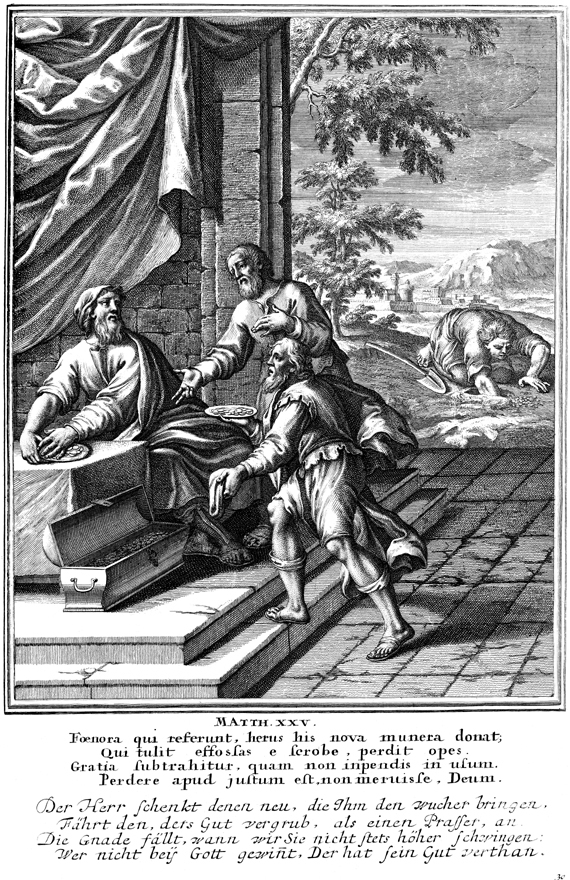
The parable appears in Matthew 25:14-30 and Luke 19:12-27. The structure is consistent:
A master gives servants money (talents or minas) before departing.
- Two servants invest and multiply what they received
- One servant buries it in the ground and returns it unchanged
- The master commends those who multiplied; condemns the one who buried
https://en.wikipedia.org/wiki/Parable_of_the_Talents
The Contrast
Generative wealth (commended):
- Invested, circulated, multiplied
- Functions like seed planted that grows into grain
- Abundance thinking: resources multiply through use
- Day 1 principle: collaboration generates more
- Currency functioning as relationship medium
Hoarded wealth (condemned):
- Buried, protected, static
- Functions like rock hidden that stays unchanged
- Scarcity thinking: resources diminish through use
- Day 3 principle: zero-sum competition
- Currency corrupted into static possession
The servant who buried the talent said: “I was afraid, and went and hid your talent in the ground” (Matthew 25:25).
Fear is the scarcity emotion. Fear of loss. Fear that using means losing. Fear that sharing means depletion. Fear is what drives alienation—the protective stance against relationship.
The master’s response: “You wicked and lazy servant… you ought to have deposited my money with the bankers, and at my coming I would have received back my own with interest” (Matthew 25:26-27).
Even the minimum expectation was circulation (banking, interest), not hoarding (burial). The master wanted the money to function as currency—flowing through the banking system, facilitating exchange, generating value through relationship.
Wheat from Seed, Not Rock from Ground
Jesus used agricultural metaphors throughout his teaching:
- The sower (Mark 4:1-20): seed scattered, some multiplies thirty, sixty, a hundredfold
- The growing seed (Mark 4:26-29): “the earth yields crops by itself”
- Wheat and tares (Matthew 13:24-30): both grow together until harvest
The principle is consistent: resources are generative, not static.
Seed planted becomes grain. Grain becomes bread. Bread feeds many. Some grain is saved as seed for next planting. The cycle continues.
This is abundance architecture: circulation and multiplication rather than accumulation and protection. Connectedness rather than alienation.
A rock buried stays a rock. It generates nothing. The earth doesn’t “yield crops by itself” from buried stones.
Hoarding wealth treats money like rocks. Circulating wealth treats money like seed.
The Feeding of the Multitudes: A Phase Change
The feeding miracles appear in all four Gospels with slight variations:
- Feeding of the 5000: Matthew 14:13-21; Mark 6:30-44; Luke 9:10-17; John 6:1-14
- Feeding of the 4000: Matthew 15:32-39; Mark 8:1-10
The Standard Reading (Miracle)
Jesus takes five loaves and two fish, blesses them, and supernaturally multiplies them to feed thousands, with baskets of leftovers.
This reading emphasizes divine power and Jesus’s identity as miracle-worker.
An Alternative Reading (Phase Change)
What if the “miracle” was a shift in mindset within the crowd—a transition from alienation to connectedness?
The disciples say: “We have here only five loaves and two fish” (Matthew 14:17). Scarcity thinking. Alienated stance.
Jesus says: “Bring them here to Me” (Matthew 14:18). Then he has the crowds sit down in groups, blesses the food, breaks it, and gives it to the disciples to distribute.
Possibility: People in the crowd had brought food for themselves (common practice for long journeys). But operating from scarcity mindset—from the alienated state—they were hoarding it, afraid there wouldn’t be enough.
When they saw Jesus and the disciples sharing openly what little they had, it triggered a phase change in the crowd’s attitude. The act of sharing became infectious. Others began contributing what they’d brought.
Suddenly, there was more than enough. Not because matter supernaturally multiplied, but because circulation replaced hoarding. Connectedness replaced alienation.
Twelve baskets of leftovers. Abundance revealed through sharing, not created ex nihilo.
Phase Change as Metaphor
In chemistry, a phase change occurs when particles remain the same but their orientation and relationships shift—ice to water, water to steam.
Same molecules. Different structure.
In the feeding miracles: same people, same food. But when scarcity thinking (Day 3: alienated, hoard what you have) shifts to abundance thinking (Day 1: connected, share what you have), the system reorganizes.
This isn’t supernatural magic. It’s structural transformation. A shift from alienation to connectedness. From men as kings to the kingdom of God.
The Kingdom of God as Economic Architecture
Jesus repeatedly described the “kingdom of God” using economic metaphors:
- Treasure hidden in a field (Matthew 13:44)
- Pearl of great price (Matthew 13:45-46)
- The laborers in the vineyard (Matthew 20:1-16)
- The wedding feast (Matthew 22:1-14)
In each case, the kingdom operates by different rules than hierarchical scarcity systems:
- The last shall be first
- Those who give receive a hundredfold
- Debt is forgiven
- Abundance is shared
These aren’t moral platitudes. They’re descriptions of how Day 1 equality systems function economically—how connectedness generates abundance.
When hierarchy is removed, scarcity thinking dissolves. When scarcity thinking dissolves, resources circulate rather than accumulate. When resources circulate, they multiply through use rather than diminish. When multiplication happens through collaboration, everyone receives more.
This is the economic architecture of connectedness.
Implications for Today
The teaching isn’t: “Wealth is evil, poverty is virtuous.”
The teaching is: What is your relationship to resources? Are you operating from connectedness or alienation?
Scarcity mindset (Day 3 / Alienation):
- Hoard for fear of loss
- Zero-sum: if you gain, I lose
- Accumulation as security
- Wealth as static, protective (rock buried)
- Competition over limited resources
- Currency corrupted into possession
Abundance mindset (Day 1 / Connectedness):
- Circulate for multiplication
- Positive-sum: we can both gain
- Generosity as investment
- Wealth as generative, productive (seed planted)
- Collaboration to increase resources
- Currency functioning as relationship medium
This applies at every scale:
- Personal finance
- Business models
- Economic policy
- International aid and development
The question isn’t “how much wealth?” It’s “is the wealth circulating or hoarded? Generative or protective? Seed or stone? Facilitating relationship or breaking it?”
Connection to the Three Days Pattern
The wealth teaching appears in Mark 10, immediately before Jesus’s third prediction of his death and resurrection (Mark 10:32-34).
The pattern holds:
- Day 3 (hierarchy/alienation): Hoarded wealth, fear-based accumulation, scarcity mindset, relationships broken
- Day 2 (transition): The command to sell and give, the choice to circulate or hoard, the moment of decision
- Day 1 (equality/connectedness): Generative wealth, hundredfold return, abundance revealed through sharing, relationships restored
The rich young ruler stayed in Day 3 alienation. He couldn’t make the transition. The possessions held him.
The disciples made the transition. They “left all”—meaning they stopped hoarding, stopped operating from alienated scarcity thinking—and entered the connected state where resources multiply.
The crowd at the feeding potentially experienced the transition. From hoarding to sharing. From scarcity to abundance. From fear to trust. From alienation to connectedness.
That’s the reversal pattern. And it’s economic as much as theological.
Conclusion
Jesus wasn’t anti-wealth. He was anti-alienation.
The parable of the talents condemns the servant who buried the money—who treated currency as static possession rather than relationship medium. The master wanted multiplication, circulation, investment—not protection, stasis, burial.
The rich young ruler wasn’t condemned for having wealth. He was shown what was blocking him from entering the kingdom of God (connectedness): his inability to circulate it. His possessions kept him in the alienated state.
The feeding miracles demonstrate what happens when scarcity thinking gives way to abundance thinking, when alienation shifts to connectedness: there’s more than enough for everyone.
Wealth functions like seed or like stone.
Planted or buried.
Generative or static.
Currency or possession.
Connectedness or alienation.
Day 1 or Day 3.
The question isn’t whether to have resources. It’s what you do with them—and what that reveals about your structural position.
Think of how this relates to the way some billionaires are carrying on in today’s world, and their claims of righteousness.
References
- Mark 6:30-44; 8:1-10 (Feeding of the 5000 and 4000)
- Mark 10:17-31 (Rich young ruler and disciples’ response)
- Matthew 13:1-23 (Parable of the sower)
- Matthew 25:14-30; Luke 19:12-27 (Parable of the talents/minas)
This framework is presented in submissions to the Royal Commission into Antisemitism and Social Cohesion. See Submission 3 for the full theological argument and Understanding the Second Parousia for an accessible summary.
1 thought on “Generative Wealth and the Abundance Principle”